


Heat protectant: when to apply it and how much you need
Your hair.
Your look.
Handle with care.
Heat protectant: when to apply it, how to distribute it and how much your hair needs.
Hairdryers, straighteners and curling tongs let you switch up your look whenever you feel like it. But there is one step you should not skip: apply heat protectant before using heat, following the product instructions. The amount depends on the formula, your hair length and density; there is no single number of sprays that works for every head of hair.
And no, a quick spritz over the top and hoping it reaches the rest does not really count as a technique. Even distribution is the key.
When should you apply heat protectant?
Before using heated styling tools. Applying it after styling does not replace protection beforehand. Adding shine to a finished look and protecting hair during drying are different functions.
On damp or dry hair? That depends on the instructions for each formula. Not all heat protectants are used in the same way, so check the directions before adding one to your routine.
How you use your tools matters too. The American Academy of Dermatology recommends combining a heat protection product with low or medium heat settings and limiting heat styling. Heat protectant helps, but it does not make your hair indestructible.

Master Touch:
protection and easier styling.
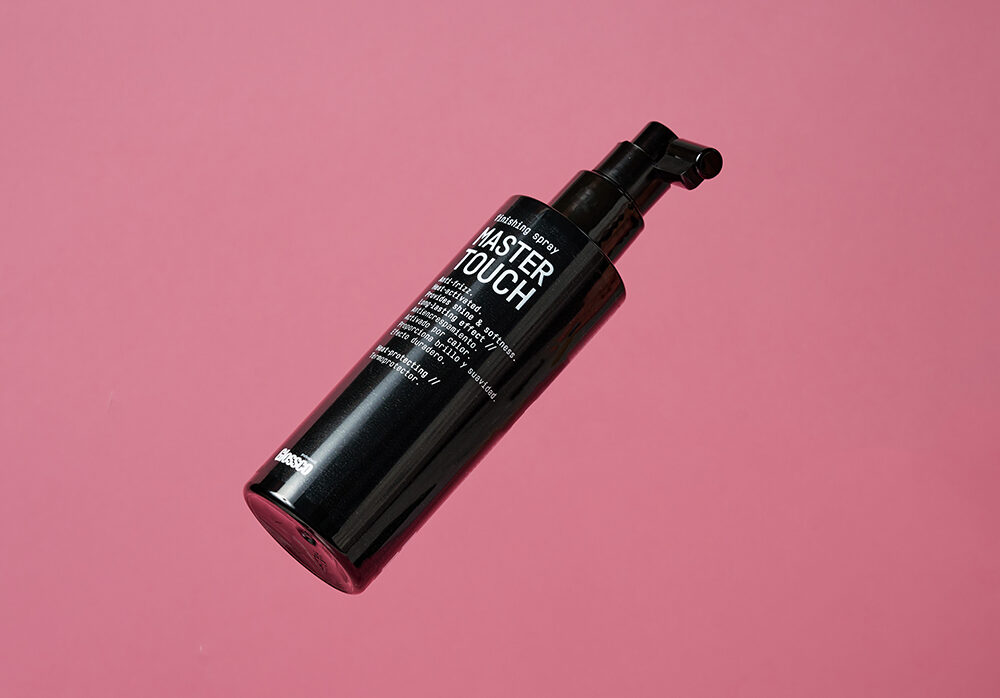
Master Touch by Glossco Professional combines heat protection, frizz control, softness and shine. It also makes brushing easier and helps improve colour retention.
Its formula contains a heat-activated polymer that helps smooth the hair and repel humidity without weighing it down. A practical option for preparing your hair and making it more manageable during styling.
Discover Master Touch ↗How to apply Master Touch
Here is how to use it:
-
Wash your hair with shampoo and a hair mask, then remove excess water with a towel.
-
Divide your hair into sections.
-
Apply along the length of each section, avoiding the roots.
-
Comb through to distribute the product.
-
Blow-dry with a brush using hot air, which is needed to activate the product.
Even distribution is the key.
How much heat protectant do you need?
The Master Touch product information does not specify a dose in millilitres or a set number of sprays. Giving an exact figure would mean inventing a level of precision that the product instructions do not provide.
As a practical guide to distribution, think about the areas you need to cover:
- Short or low-density hair Work in sections suited to your haircut so you can control where you apply the product.
- Long hair Pay attention to the full length; concentrating the product on the ends leaves the rest unevenly covered.
- High-density hair Create more sections so you can reach the inner layers too.
The aim is not to finish the bottle faster. It is to avoid leaving all the product on the outer layers.
If you struggle to judge the amount, your hair professional can show you how to distribute it for your cut and density. That is more useful than copying the number of sprays used by someone with twice as much hair.
Three mistakes to avoid
Remembering it after you have finished
Keep your heat protectant next to your hairdryer so it becomes part of the preparation, rather than an “I knew I had forgotten something” moment.
Treating protection as permission to turn up the heat
Use only as much heat as needed and avoid repeatedly going over the same section. The highest setting does not have to be your default.
Using straighteners on damp hair
Your hair should be dry before you use them, as the American Academy of Dermatology explains in its styling advice.
Frequently asked questions
Do I need heat protectant if I only use a hairdryer?
Yes, a hairdryer also exposes your hair to heat. Protection is not just for the days when you use straighteners.
Can I apply Master Touch after styling?
To use it for preparation and heat protection, follow the instructions and apply it to towel-dried hair before blow-drying. Applying it afterwards does not replace this step.
Does more product mean more protection?
Do not assume so. Follow the product instructions and focus on even distribution, without unnecessarily building up product in one area.